Thursday, July 8, 2010

My workspace

This is the 1:100 model of the site that I am working on. I am keeping the old floating stage that is now on the site, just moving it a little to the side, allowing the bath to come up next to it. I'm also adding smaller floating platforms - floating stepping stones - that allows someone on the floating stage to hop on to the body of the bath. The stepping stones move according to tide, whilst the bath itself is drowned and revealed as tide moves up and down. I imagine levels on the body of the bath that can be entered from the stepping stones only when the tide is at a specific level.

Concept model 7 - entering situation

This model is further investigating the entering situation with the bridge, as found in the previous model. The bridge has a generous size, two meters wide in this 1:100 scale model. As it touches land it splits somewhat and allows for a less dominant role on the port side. In the cracks wild grass from the site is allowed to grow. Pictures from site will come. Also this model shows how the same vegetation is found on the body of the structure, and on the land leading up to the bath. The surrounding area leading from the road to the bath I propose not to be planned for buildings, but to have a sea side park with the kind of flora natural to the place. This park area will have different situations, some benches, larger or smaller areas for hanging out and enjoying the atmosphere. This also creates a whole new entry/exit to the city for those using the coastal steamer. The natural landscape of Norway is not the renaissance parks found in the central area of Bergen. I am inspired by the renovation of the elevated rail road, now park, in NY.

Concept model 6 - tactility and atmosphere

This concept model shows a structure set out from land. There is land vegetation on the upper body and sea vegetation and fauna on the lower level of the body. You can see through the structure to the other side. What I really like about this model is the composition of materials and colours, scale and the sense of calm lonesomeness in the different situations. Also I like the sense of mystery about the space.

Mystery in wiktinary:

Etymology

From Middle English mysterie < Latin mysterium < Ancient Greek μυστήριον (musterion), “‘a mystery, a secret, a secret rite’”) < μύστης (mustēs), “‘initiated one’”) < μυέω (mueō), “‘I initiate’”) < μύω (muō), “‘I shut’”).

[edit] Noun

Singular
mystery


Plural
mysteries

mystery (plural mysteries)

  1. Something secret or unexplainable; unknown.
    The truth behind the events remains a mystery.
  2. Someone or thing with an obscure or puzzling nature.
    That man is a mystery.
  3. (Catholicism) A particular event or series of events in the life of Christ.
    The second decade of the Rosary concerns the Sorrowful mysteries, such as the crucifixion and the crowning with thorns.

Materialarium - sea stuff

Some examples from my collection of materials from the sea. Sea flora and shells that grow on shells. Rounded enclosed shapes is the most energy efficient way of construction. Layering. Wood shaped over time in climate.

Membrane, shell structure investigation

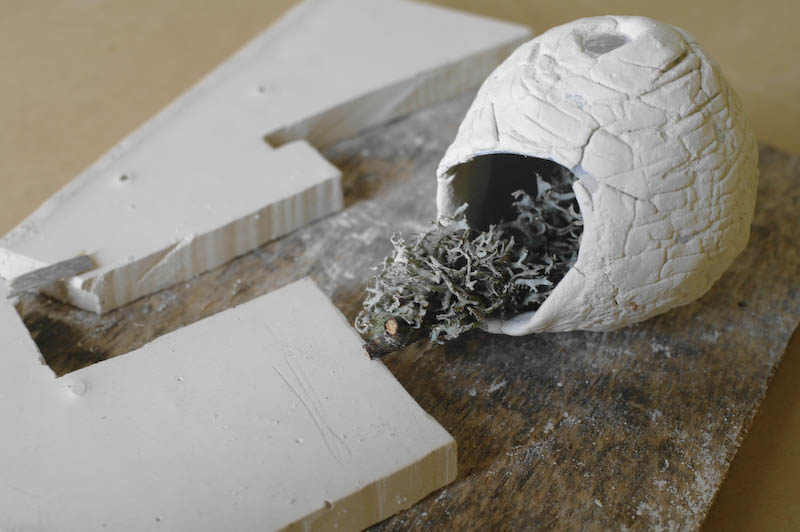
Continuing the shell structure investigation I made these small experiments with clay and reinforcement. I like the repetitive cracks that the reinforcement makes in the structure. These cracks could be used for letting light in or vegetation to grow, for climbing on...

Shell structure investigation

Inspired by the creatures of the sea I investigated different shell structures. These could be constructed by ready made concrete cylindrical building elements used in construction.

Concept model 5 - vertical and horizontal layers

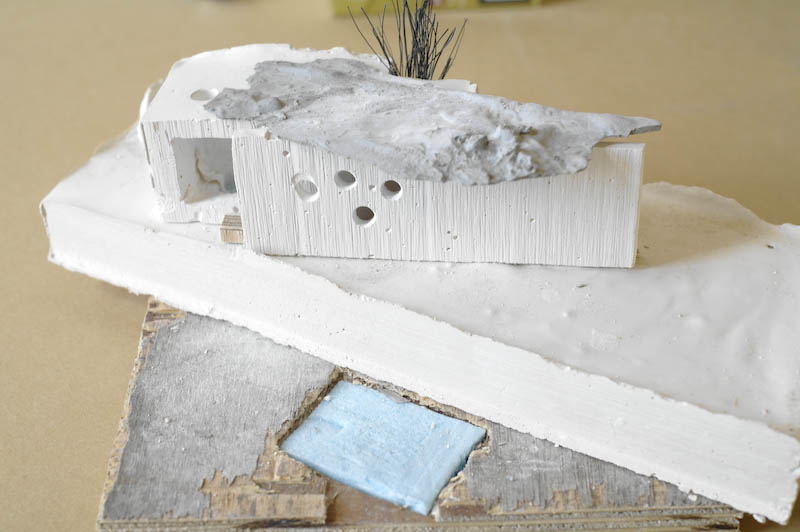
This model shows some smaller situations. An outside situation where the body of the build offers vegetation to grow on it, a long hall with round windows, a smaller intimate crypt with a small bath, that lets in light from above. Below is anther source of water, maybe seawater coming in through a hole in the floor.

Also in this model I experimented composition of materials; the main build is in a harder material with slick surfaces. In the hall there is soft wood to walk on. The roof of the hall that extends over the main build is a rougher, darker material.

Concept model 4 - the generous facade

I imagine that the body of the skinship can be available to people that are not using the inside. At the site, an industrial area slowly in transformation, many people already finding small intimate spaces to hang out. I believe they experience it as finding special secret places, and this is a notion I would like to work with and preserve.

Concept model 3 - private and public

One of my early findings, a wasps nest, finally found its place. With its delicate walls it represents the apparent transparency or availability that I look for at the bath, or the skinship. The web that embraces the nest represents the contact with the city, how it is a closed entity, but it is also linked to the city.

In Japan and South Korea, the term "skinship" (Japanese: sukinshippu (スキンシップ?); Korean: 스킨십) is used to describe the intimacy, or closeness, between a mother and a child. Today, the word is generally used for bonding through physical contact, such as holding hands, hugging, or parents washing their child at a bath. (wikipedia)

Skinship n. Feelings of relatedness and affection between two people, particularly a mother and a child, caused by hugging, touching, and other forms of physical contact. (wordspy)

Further, the theory that physical intimacy leads to emotional intimacy.


Concept model 2 of bath - difference in temperature

This is a concept model made just after my last talk with my tutors. The fluffy mass that enters the bulb represents warm space, the rugged bulb is an embracing skin. Between the insides of the bulb and the walls of the warm space is a cool space. Here enters water from the sea. There is an opening in the top letting in sunlight from above. Also rainwater enters here and runs down the outside walls of the warm internal space.

On the bottom picture can be seen the cuts made in the façade to let in additional light into the cold space. Reference to the video posted earlier. After more investigation turns out that this kind of light happens when reflected light from the sea breaks on a reflective surface (could be glass or some kind of metal). In the break the light is thrown at a specific angle on inside walls, always changing with the angle the sunlight hits the water surface.
 
 
Copyright © Suchness
Blogger Theme by BloggerThemes Design by Diovo.com